
Why Would a Sports Professional Need a Diploma in Biomechanics Coaching? Part 3: A Coach's Perspective
Own Your Pitch Series | Part 3 of 3
Own Your Pitch Series | Part 3 of 3
Throughout this series, we have looked at Biomechanics Coaching through two lenses, the practitioner who delivers it, and the athlete who benefits from it. In this final part, we shift to a third and equally important perspective: the professional coach.
Within elite sporting environments, it is often the coaching staff who identify the gaps first. They recognise when an athlete’s movements are becoming a liability, and they understand that physical resilience and technical performance are not separate conversations. Increasingly, they are looking for movement professionals with the depth of knowledge to work meaningfully alongside them.
Mark Laws is one of those coaches. Mark brings a professional coaching background that gives him a unique view of where a biomechanical expertise fits within the modern sporting landscape and why it matters more than ever.
Professional coaching has always been concerned with performance. But the understanding of what drives performance has become considerably more sophisticated. Strength and conditioning, nutrition, sports psychology, and recovery science have all found their place in the backroom staff of high-performing teams. Movement quality and Biomechanics Coaching are following the same trajectory.
For coaches working at professional and semi-professional level, the ability to identify movement risk, and to have a trusted practitioner who can address it, is increasingly seen not as a luxury but as a necessity. The logic is straightforward: athletes who move well stay available, and availability is the foundation of consistent performance. In professional sport, consistency is what ultimately wins seasons.
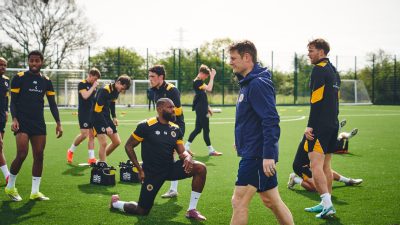
Mark Laws is a professional coach currently working with Boston United football club. Here, he shares where he sees the real value of biomechanics-trained movement professionals within elite sporting environments.
The role of a biomechanics-trained movement professional within a sporting team is distinct from that of a physiotherapist, a strength and conditioning coach, or a personal trainer, though it complements all three. Where a physio manages injury, and an S&C coach builds physical capacity, a Biomechanics Coach addresses the movements that sit underneath both.
They are asking different questions. Not just “is this athlete fit?” or “is this athlete strong?” but “is this athlete moving in a way that supports long-term performance?” That lens; preventive, analytical, and rooted in movement science, is one that professional coaching environments are increasingly recognising as essential.
Sports performance coaching that integrates a biomechanical approach creates a more complete picture of the athlete. It enables coaching staff to make better informed decisions about training load, technical development, and return-to-play timelines. And it gives the athlete a practitioner who can work across the full arc of their performance journey, not just at the point of breakdown.
The World Cup puts elite sport and the professionals behind it, firmly in the spotlight. It is a reminder that the teams who perform consistently at the highest level are supported by ecosystems of expertise, and that movement practitioners with genuine understand of biomechanical knowledge are an increasingly valued part of that ecosystem.
For exercise professionals ready to step into professional and semi-professional sporting environments, the pathway is clear. Build the expertise. Develop the framework. Earn the credibility. Take ownership of your professional development and position yourself for the spaces where your skills can have a real, lasting impact.
The Diploma in Biomechanics Coaching is how you get there.